

What does the Austin housing market in September 2026 mean for buyers and sellers? A market headline can tell you sales slowed down. It can’t tell you whether the house you’re considering is priced well—or what it will take to sell your own.
That’s where I like to take a closer look. September’s Austin-area housing report shows fewer completed sales alongside a slightly higher median sale price. Those numbers can coexist, and understanding why is more useful than trying to label the entire market “good” or “bad.”
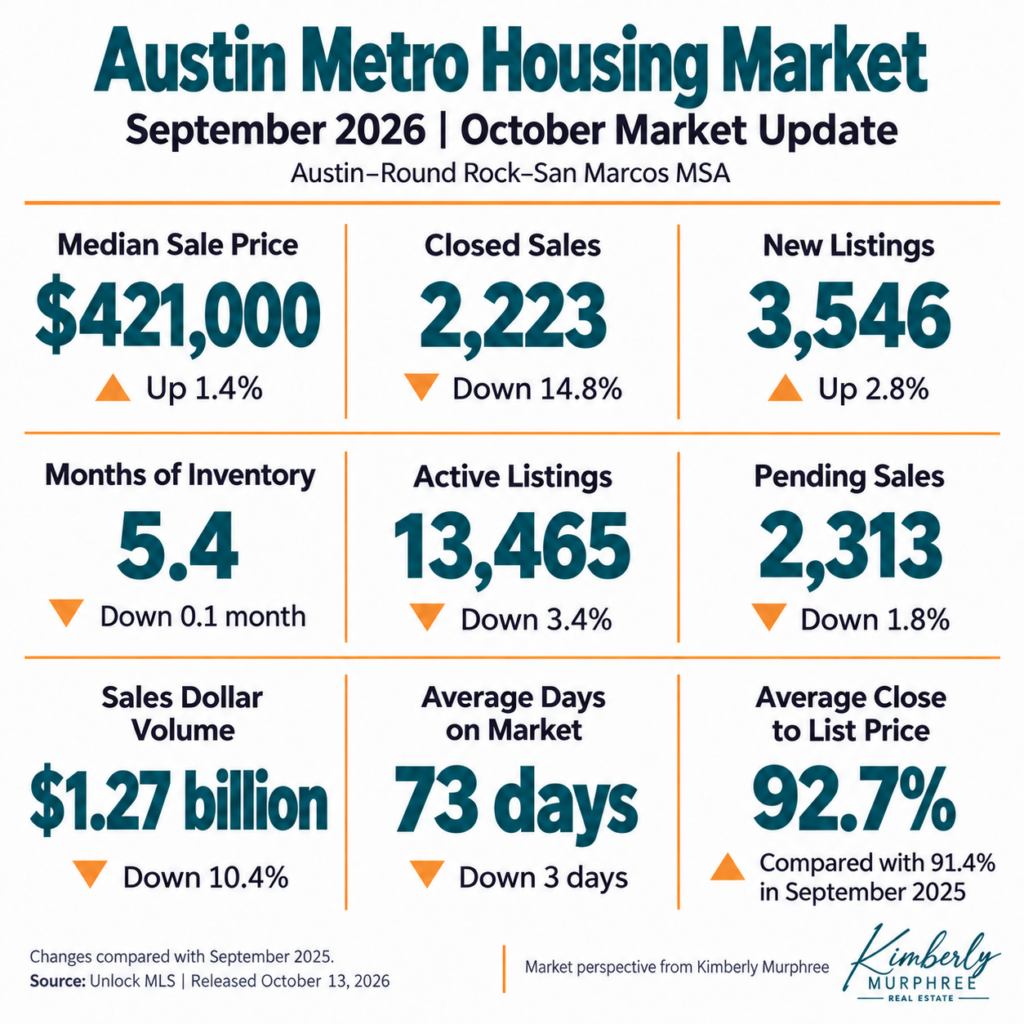
Austin housing market September 2026: Key statistics
According to Unlock MLS, the following figures cover the Austin–Round Rock–San Marcos metropolitan area, rather than the City of Austin alone. Comparisons are with September 2025.
| Measure | September 2026 | Year-over-year comparison |
|---|---|---|
| Median sale price | $421,000 | Up 1.4% |
| Closed sales | 2,223 | Down 14.8% |
| New listings | 3,546 | Up 2.8% |
| Months of inventory | 5.4 months | Down 0.1 month |
| Active listings | 13,465 | Down 3.4% |
| Pending sales | 2,313 | Down 1.8% |
| Sales dollar volume | Approximately $1.27 billion | Down 10.4% |
| Average days on market | 73 days | Down 3 days |
| Average close to original list price | 92.7% | Compared with 91.4% |
Why fewer sales don’t automatically mean lower prices
The median sale price is the midpoint of the homes that sold. It can shift when the mix of sales changes—for example, if more higher-priced homes make up that month’s closings.
So a higher median doesn’t mean every homeowner gained the same amount in value. And fewer closings don’t tell us how much an individual seller might negotiate.
When I help someone make a decision, I want to look at the homes buyers are actually comparing: similar location, size, condition, and price range.
What the other numbers tell us
Sales dollar volume combines the value of all completed sales. It helps describe overall activity, but it doesn’t tell us what a particular home is worth.
The 73-day average gives buyers and sellers some context for timing. It isn’t a deadline or a prediction for your home; individual properties can move much faster or take longer.
The close-to-original-list-price figure also needs context. An average of 92.7% doesn’t mean every buyer should offer 7.3% below asking. That measure compares completed sales with their original asking prices, which may differ from the prices advertised when buyers made their offers.
What Austin home buyers should consider
Start with a monthly payment that feels comfortable for your household. Then consider what the homes in your budget offer and what tradeoffs you’re willing to make.
Before choosing an offer price, I would look at recent comparable sales, current alternatives, the home’s condition, and its pricing history. Depending on the property and seller’s circumstances, we might also discuss repairs, closing costs, or timing.
A slower regional sales pace is useful context. The individual property still needs its own evaluation. Learn more about buying a home with me.
What Austin home sellers should consider
I would be careful about using the higher metro median as a reason to raise your asking price.
Instead, let’s look at your competition and the most relevant completed sales. From there, we can decide how to prepare your home, present it clearly, and set a price that makes sense for your goals.
It also helps to agree on how we’ll evaluate the response once your home is available. Showing activity and buyer feedback can help us decide whether the plan needs adjusting. Here’s more about my approach to selling your home.
What matters for your move
You don’t have to predict the next market headline to make a thoughtful decision. You do need a clear picture of your options, your timeline, and the numbers closest to your situation.
If you’re considering buying or selling around Austin, reach out. I’m happy to help you sort through what this market means for you.
Source: Unlock MLS September 2026 Central Texas Housing Report, released October 13, 2026. Statistics refer to the Austin–Round Rock–San Marcos MSA. Sales dollar volume is rounded.
